














Inhalt
- Germinating cannabis seeds with paper towels
- Germinating cannabis seeds in water
- Germinating cannabis seeds directly in soil or starter cubes
- Cannabis seed germination temperature and humidity
- How long do cannabis seeds take to germinate
- Germinating autoflowering seeds
- Germinating feminised seeds compared with regular seeds
- Why seeds do not germinate: the most common mistakes
- Planting germinated seeds
- How long do cannabis seeds last
- Sources
 Passend zum Artikel
2ML HHZ Vape Pen 95% - Amnesia
€49,90
Ansehen
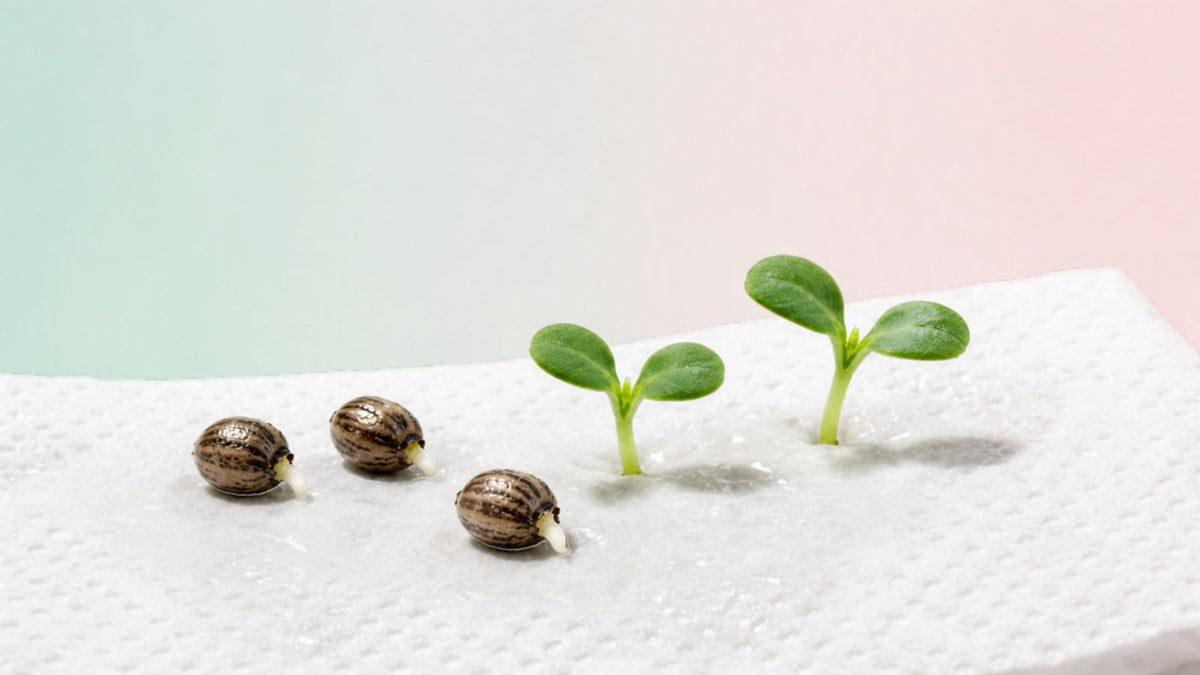
Cannabis seeds germinate most reliably at about 20 to 25 °C, in the dark and in an evenly moist but not wet environment. Under these conditions, fresh seeds usually show the first white taproot after 24 to 72 hours. The method you use matters less than the conditions: paper towels, a glass of water, soil and starter cubes all work, and they differ mainly in control, effort and risk to the delicate root.
Key facts
- Guide value for germination temperature: 20 to 25 °C
- Fresh seeds usually germinate after 1 to 3 days, older ones need up to 7 days or longer
- In a glass of water for 24 hours at most, then onto paper towels or into soil
- Plant as soon as the taproot is about 0.5 to 1 cm long
- Storage: cool, dark, dry and airtight
Germinating cannabis seeds with paper towels
The paper towel method is the best known because you can check every seed each day. You place two layers of paper towel on a plate, moisten them with room temperature water and let the excess water drain off. The paper should be damp but not dripping.
- Place the seeds on the damp layer with a little space between them.
- Cover them with a second damp layer.
- Put a second plate upside down on top so that nothing dries out and it stays dark.
- Put the plates in a warm place, for example near a radiator, but not directly on it.
- Check once a day and moisten the paper again if needed.
The drawback: you have to handle the germinated seed when you move it. If you wait too long, the fine root grows into the fibres of the paper and can then tear off.
Germinating cannabis seeds in water
In a glass of water the seed shell soaks up water quickly, which speeds up the start of germination. You put the seeds in a glass of room temperature water and keep it dark and warm. Many seeds float at first and sink after a few hours.
After 12 to 24 hours the shells of fresh seeds often open already. At the latest then, they belong on damp paper towels or directly in the soil. If seeds stay in the water much longer, they lack oxygen and can rot. The glass of water is therefore best used as a first step, especially for older seeds with a hard shell.
Germinating cannabis seeds directly in soil or starter cubes
Placed directly in soil or in a starter cube, the taproot never has to move. This is the gentlest method, but you only see progress when the seedling breaks through the surface. This usually takes 3 to 7 days.
Loose, low nutrient seedling soil that has been moistened evenly beforehand is suitable. The seed goes about 0.5 to 1 cm deep into the soil. Starter cubes made of peat, coco fibre or rockwool are soaked in water first and then squeezed out lightly. You find feminised and autoflowering seeds for your start in our grow range.
| Method | Typical time until the taproot | Advantages | Disadvantages |
|---|---|---|---|
| Paper towels | 1 to 5 days | Good control, little material | Transplanting needed, paper dries out quickly |
| Glass of water | 12 to 48 hours until the shell cracks | Fast start, good for hard shells | 24 hours at most, otherwise risk of rot |
| Directly in soil | 3 to 7 days until the seedling is visible | No transplanting, no root stress | No visual check, waterlogging possible |
| Starter cubes | 2 to 7 days | Even moisture, easy to transplant | Extra material, cube can dry out |
Cannabis seed germination temperature and humidity
The guide values are 20 to 25 °C, high humidity and a moist but airy germination medium. Below about 18 °C germination slows down considerably. Above 30 °C the risk rises that seeds dry out or mould forms.
Moisture is the most important factor. The seed needs water so that the shell swells, and at the same time oxygen so that the seedling can breathe. A medium that feels like a squeezed out sponge is ideal. The seed does not need light in this phase. Light only becomes important once the seed leaves appear above the soil.
How long do cannabis seeds take to germinate
Fresh, properly stored seeds usually germinate within 1 to 3 days, and some need up to 7 days. Older seeds or seeds with a very hard shell sometimes take 10 days or longer. It is then important to keep the conditions constant and not to give up too early.
After planting, it takes another 2 to 7 days or so until the seedling with its two round seed leaves is visible. The timing depends strongly on temperature, the age of the seeds and the method.
Germinating autoflowering seeds
Autoflowering seeds germinate just like other seeds, but they react more sensitively to transplant stress. Autoflower strains start to flower at a certain age, independent of the light cycle. Every day the young plant spends recovering from a move is missing later for growth.

Autoflowers are therefore often placed directly in their final pot or in a starter cube that later moves without any root contact. If you use the paper towel method, plant early, as soon as the taproot is visible. Examples from our range are Mimosa Cake, Mandarine Cream and Strawberry Shortcake as autoflowering seeds.
Germinating feminised seeds compared with regular seeds
For germination there is no difference in temperature, moisture or method between feminised, regular and autoflowering seeds. The difference lies in the genetics. Feminised seeds are bred so that female plants develop. Regular seeds produce male and female plants, which only shows in the pre-flowering stage, not during germination.

- Feminised: female plants, flowering controlled by the light cycle, examples in our range are Sour Aloha, Insanity OG and Mochi.
- Autoflowering: flowering starts by age, short life cycle, avoid transplanting where possible.
- Regular: male and female plants, the sex cannot be seen during germination.
You find our range of feminised and autoflowering seeds with details on the genetics in the cannabis seeds category. How strain names come about and what is behind well known names is explained in our article on strain names such as Amnesia, Northern Lights and Gorilla Glue.
Why seeds do not germinate: the most common mistakes
Most of the time the cause is too much water, too little warmth or old, badly stored seeds. Individual seeds do not germinate even under good conditions, and nobody can promise a germination rate of 100 percent. If several seeds fail, it is worth checking these points:
- Too wet: in water or in waterlogged soil the seed lacks oxygen and rots.
- Too dry: paper towels dry out overnight and germination stops.
- Too cold: a cool windowsill in winter slows germination down strongly.
- Planted too deep: the seedling does not reach the surface.
- Damaged root: touching it with your fingers or tearing it off the paper.
- Old seeds: viability decreases with age and with warm, humid storage.
Planting germinated seeds
A germinated seed goes about 0.5 to 1 cm deep into pre-moistened soil with the taproot facing down. It is best to plant it as soon as the root is 0.5 to 1 cm long. With clean tweezers or a spoon you avoid touching the root.
- Press a small hole into the moist soil with a pencil.
- Place the seed in it with the root facing down.
- Cover it loosely with soil and do not press it down.
- Keep the surface moist with a spray bottle instead of watering.
After a few days the seedling pushes through the soil with its seed leaves. From now on it needs light, an even temperature and rather little water.
Whether and to what extent growing cannabis is permitted depends on the country. In Germany, the Konsumcannabisgesetz (Consumer Cannabis Act) regulates the handling of seeds in § 4 KCanG and private home growing by adults, among other things with a limit of three plants at the same time, in § 9 KCanG (as of 21 November 2026). Austria and Switzerland have their own rules, and the current text of the law is always decisive.
How long do cannabis seeds last
Stored cool, dark and dry, cannabis seeds stay viable for several years, but the germination rate drops over time. Moisture, heat and light do the most damage to the seed shell and the embryo inside. Frequent changes in temperature also shorten the shelf life.
- Keep them in the original packaging or in an airtight container.
- Store them in the dark at an evenly cool temperature, for example in the fridge in a closed tin.
- Add a small desiccant bag against moisture.
- Only open the container briefly so that no condensation forms.
If you store seeds for a longer time, let them come to room temperature for one to two hours before you open the packaging and germinate them. You find general information on our page with legal notices.
Sources
Produkte aus dem Artikel