




Cannabidiol is one of the most intensely researched plant compounds of the past ten years. Still, the answer to the question of what exactly CBD FLOWERS do isn’t as simple as many marketing texts suggest. There are solid indications. But there’s also plenty of marketing that cites studies which don’t actually support the promised effects.
This article sorts things out. What is clinically proven, and what isn’t? What patterns of experience keep coming up in forums? And what should you look out for before buying, so you don’t end up with a bag of half-dried Flowers?
One thing up front: Promises of healing are off-limits for CBD for legal reasons. What you read here is context, not medical advice.
What are CBD hemp flowers?
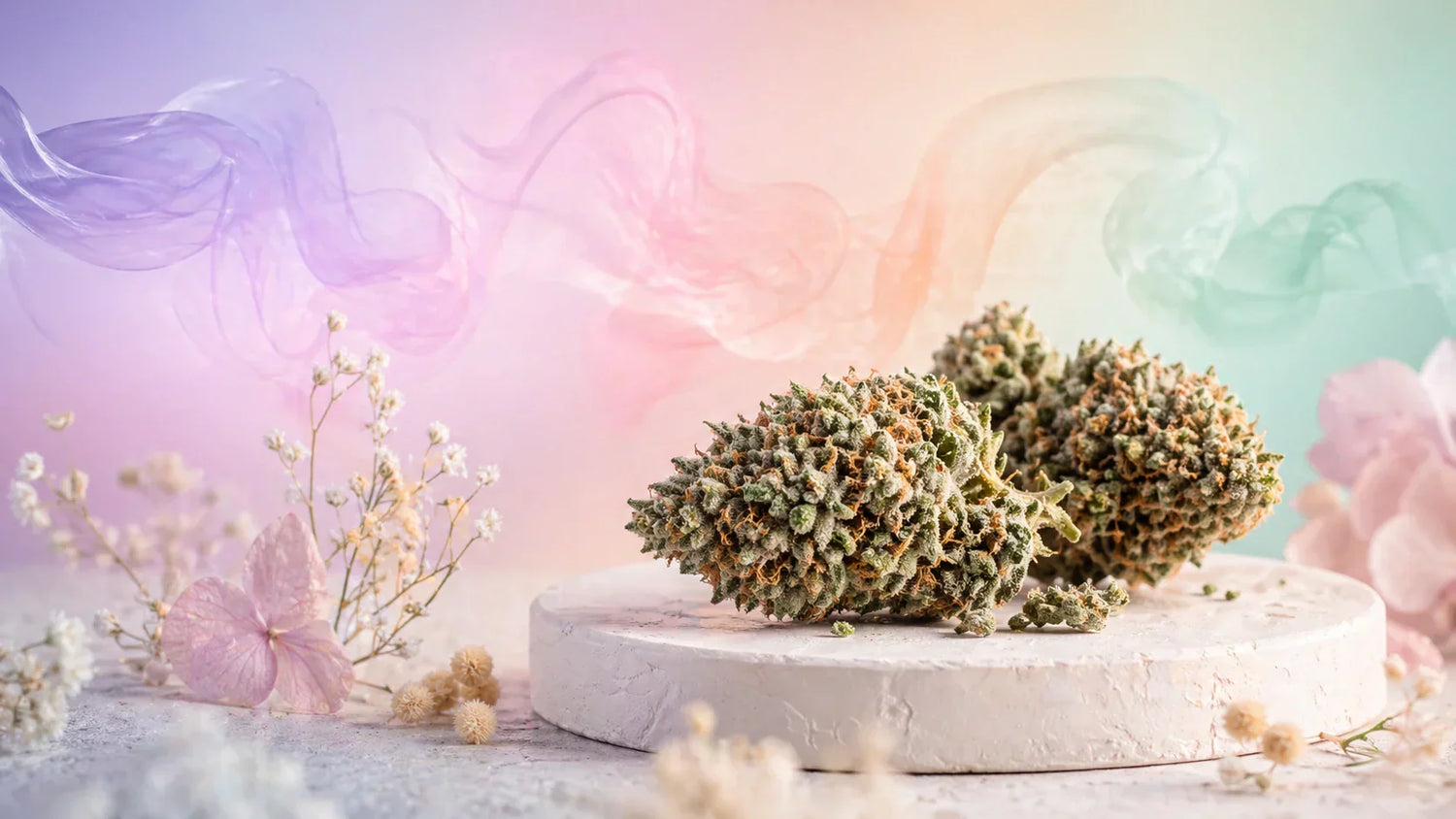
CBD FLOWERS are the dried flower clusters of the female industrial hemp plant, botanically Cannabis Sativa L. They contain cannabidiol, other cannabinoids like CBG and CBC, as well as Terpene and flavonoids. The psychoactive component is almost completely absent. Commercially available CBD FLOWERS in Germany must not exceed the THC limit and therefore remain below the threshold for intoxication.
CBD and THC compared
THC is the Cannabinoid with psychoactive effects. Outside of medical use, it’s regulated in Germany. CBD does not cause intoxication. In research and user reports, it regularly appears in the context of relaxation and sleep, without altering perception.
CBD effects in the body: How cannabidiol works
Both cannabinoids act on the body’s own endocannabinoid system, but differently. THC binds directly to CB1 receptors and triggers the classic high. CBD barely binds to these receptors. Instead, it modulates them indirectly and also influences serotonin and vanilloid receptors. It also slows the breakdown of the body’s own cannabinoids like anandamide. The effect of CBD in the body is therefore milder than that of THC, but broader in scope. That’s exactly why people respond to it so differently.

The power lies in the trichomes
If a flower feels sticky under your thumb, that’s the trichomes. These crystalline glands produce cannabinoids and Terpene. A dense, resinous layer isn’t just for looks—it’s a sign: harvested late, carefully dried, higher concentration of active compounds. If you want to know what to look for when buying, start here.
CBD FLOWERS studies: What’s scientifically proven
Almost all All clinical studies use isolated CBD or extracts, not Flowers as the final product. So you can’t transfer the results one-to-one. But they do show what cannabidiol does pharmacologically. And what it doesn’t.
Tension and sleep: Shannon 2019
A widely cited case series in the Permanente Journal followed 72 adults with anxiety or sleep problems over three months (Shannon et al., 2019). In the first month, 79.2% of participants reported a reduced anxiety score. For sleep, it was 66.7%. Sounds promising. But the authors themselves temper expectations. It’s an open case series without a control group. Before this counts as solid evidence, controlled studies would be needed. (DOI: 10.7812/TPP/18-041)
Sleep overview: Suraev 2020
Suraev and colleagues reviewed the evidence on cannabinoids for sleep disorders in Sleep Medicine Reviews in 2020. Their conclusion: The evidence isn’t strong enough to recommend CBD as a sleep aid across the board. Effects have been documented for certain Cannabinoid combinations. For CBD alone, the picture remains mixed. (PubMed: 32428841)
Antioxidant properties: Atalay 2020
Atalay et al. summarized in the journal Antioxidants in 2020 what CBD does in cell and animal models. The substance reacts with free radicals and interacts with inflammation-related signaling pathways. That’s pharmacology at the lab level. For humans, this data is a starting point, not proof. What works in a test tube doesn’t automatically work in the body. (DOI: 10.3390/antiox9010021)
The entourage effect: Russo 2019
With full-spectrum products like Flowers, one argument comes up often: cannabinoids and Terpene work together differently than isolated CBD. This hypothesis is called the entourage effect. Ethan Russo laid out the pharmacological reasoning for it in detail in Frontiers in Plant Science in 2019. In the same article, though, he also notes that robust clinical evidence is still lacking. The idea is plausible. It just hasn’t been proven. (DOI: 10.3389/fpls.2018.01969)
For context: CBD is not an approved medicinal product in Germany. Claims about medical effects are not allowed in commerce, no matter how promising the studies may sound at times.

Study and batch are two different things
What science knows about CBD doesn’t tell you what’s actually in your specific bag. That’s what the Certificate of Analysis shows: measured CBD content, measured THC content, terpene profile, and proof that there are no pesticides, heavy metals, or mold spores. Without a CoA, no one is selling you clarity—just hope.
CBD FLOWERS experiences: What patterns users report
Forums aren’t a substitute for studies. But they do show how people actually use CBD in everyday life, outside of laboratory conditions. Three patterns keep coming up in German-speaking communities and reviews.
The transition into the evening
The most common situation is also the calmest: after work, before going to bed. Many describe the feeling as “mentally winding down,” others as “the mind gets quieter.” How noticeable the effect is varies betwee
Sleep, but not as a pill
CBD is often included in an evening routine, not used as a knockout drop. If you're expecting a sleeping pill, you'll be disappointed. But if you just want to wind down in the evening, sometimes that's exactly what you get. This range fits with what Shannon and Suraev observed in their data.
What no one describes
What you almost never read in reputable reports about legal CBD FLOWERS: intoxication, altered perception, loss of control. This matches the low THC concentration and the pharmacological classification of CBD. If you're worried about that, you can relax.
Why some people feel nothing at all
CBD enters a complex system. Metabolism, daily condition, expectations, chosen variety—all of this changes what you notice. Some people react immediately, others only after days. Some aren't affected at all. That's not a sign of poor quality. Often, it simply helps to try a different variety or change the time of use.
Varieties at a glance: Indica, Sativa, Hybrid
The classification into Indica and Sativa is botanically disputed. Still, it persists in the market because it roughly matches terpene profiles. And Terpene shape the taste and character.
- Indica-dominant: calming, earthy to sweet. Higher myrcene content. Popular for evenings.
- Sativa-dominant: clearer in the head, fruity-citrus notes. Limonene or pinene in the profile. Better for daytime.
- Hybrid: balanced. A good choice if you don't yet know how you'll react to CBD.
A curated overview with transparent variety information, measured CBD content, and origin can be found in the CBD FLOWERS collection on ilovepot.de. Each variety also shows its Cannabinoid and terpene profile. This way, you compare what matters, not just brand names.

Choose by profile, not by name
"Northern Lights" sounds nice. But it doesn't say much about what actually happens in the bag. Choose by terpene profile. Myrcene-rich varieties feel different from those high in limonene. That's exactly what the Cannabinoid and terpene information on the product pages are for.
What to look for when buying
The quality of a flower is determined long before shipping: during cultivation, at harvest time, during drying, during trimming. Four points matter when buying.
1. Lab analysis for each batch
Reputable suppliers publish an independent Certificate of Analysis for each batch. CBD and THC content, pesticides, heavy metals, and microbiological purity are tested. If there's no CoA, there's no proof—just a claim.
2. Origin and cultivation
EU-certified industrial hemp, ideally from organic cultivation without synthetic plant protection agents. This information should be clearly visible on the product page, not hidden in the fine print at the bottom.
3. Trimming and appearance
High-quality Flowers are dense, resinous, and neatly trimmed. They smell aromatic and true to their variety. Musty or dull aromas are a warning sign: harvested too early, dried too quickly, or poorly stored.
4. Transparency in the shop
CBD content, THC value, batch, harvest year, variety name. If this isn't shown, either the data isn't available or they don't want to show it. Neither is a good sign. On the product pages of our CBD FLOWERS you'll find this information for each variety.
View tested CBD FLOWERS with lab certificate
To the CBD FLOWERS selection on ilovepot.de →Legal situation in Germany
CBD FLOWERS from EU-certified industrial hemp are offered in Germany as long as the THC content stays below the legal threshold. With the Cannabis Act (CanG) and the Consumption Cannabis Act of 2024, the overall framework for cannabis has changed. For industrial hemp products, separate rules still apply, which authorities continue to specify. What this means for you: Before you order, quickly check the current situation in your federal state.
Conclusion on CBD FLOWERS effects
Research on CBD has broadened. There are indications for stress, sleep, and antioxidant properties. But rarely the certainty that some advertising suggests. Experience reports show a unique, consistent picture: CBD works individually. Sometimes clearly, sometimes hardly at all. If you want to try it, look for lab certificates, transparent origin, and a variety profile that suits you. The rest, your own body will tell you.
The contents of this article are general information and do not replace medical or pharmaceutical advice. If you have health concerns, please consult qualified medical professionals. The linked studies lead to the respective original publications.
